Friday, March 23, 2012

Tuesday, March 20, 2012
Mascot Mayhem
The "Brave," an American Indian warrior, became the symbol of the Talawanda Schools in the 50s.
But who was Talawanda?
The Coalition for a New Talawanda Mascot fought to remove the Braves mascot from the Talawanda school district in 2010.
How did the NCAA rule on the use of Inidian Mascots in the March Madness Tournament?
What do you think?
Thursday, March 15, 2012
March Madness
Mitt Romney clearly is not running to be the nation's top sports fan. The GOP presidential candidate says he won't be filling out a college basketball tournament bracket, an annual tradition for millions of Americans including President Barack Obama."I'm not plugged in well enough this year to do that," Romney said Tuesday during a brief exchange with reporters traveling with him in Missouri.
Basketball player and fan Obama is making his NCAA tournament predictions public for a third straight year. ESPN on Tuesday revealed Obama's Final Four: Kentucky, Ohio State, Missouri and North Carolina. ESPN said it would unveil the president's entire bracket on Wednesday.
Think you can beat the President: fill out your own bracket.
Friday, March 9, 2012
Who Is Mr. Kony?
KONY 2012 from INVISIBLE CHILDREN on Vimeo.
If you'd asked me that just last week I'd have said you could find him at 'Skyline.'

The online video about the Ugandan Resistance Army leader — who is wanted by the International Criminal Court for crimes against humanity and war crimes including murder, sexual slavery and abusing children — now ranks as the fastest-growing viral campaign in history, according to online measurement firm Visible Measures Corp. The clip sought to make Joseph Kony famous in order to spur his eventual capture.
Posted to YouTube on Monday by the non-profit group Invisible Children Inc., the 30-minute video captured more than 70 million views by Friday morning, with more than 200 clips associated with it and more than 500,000 comments.
Where is Uganda?
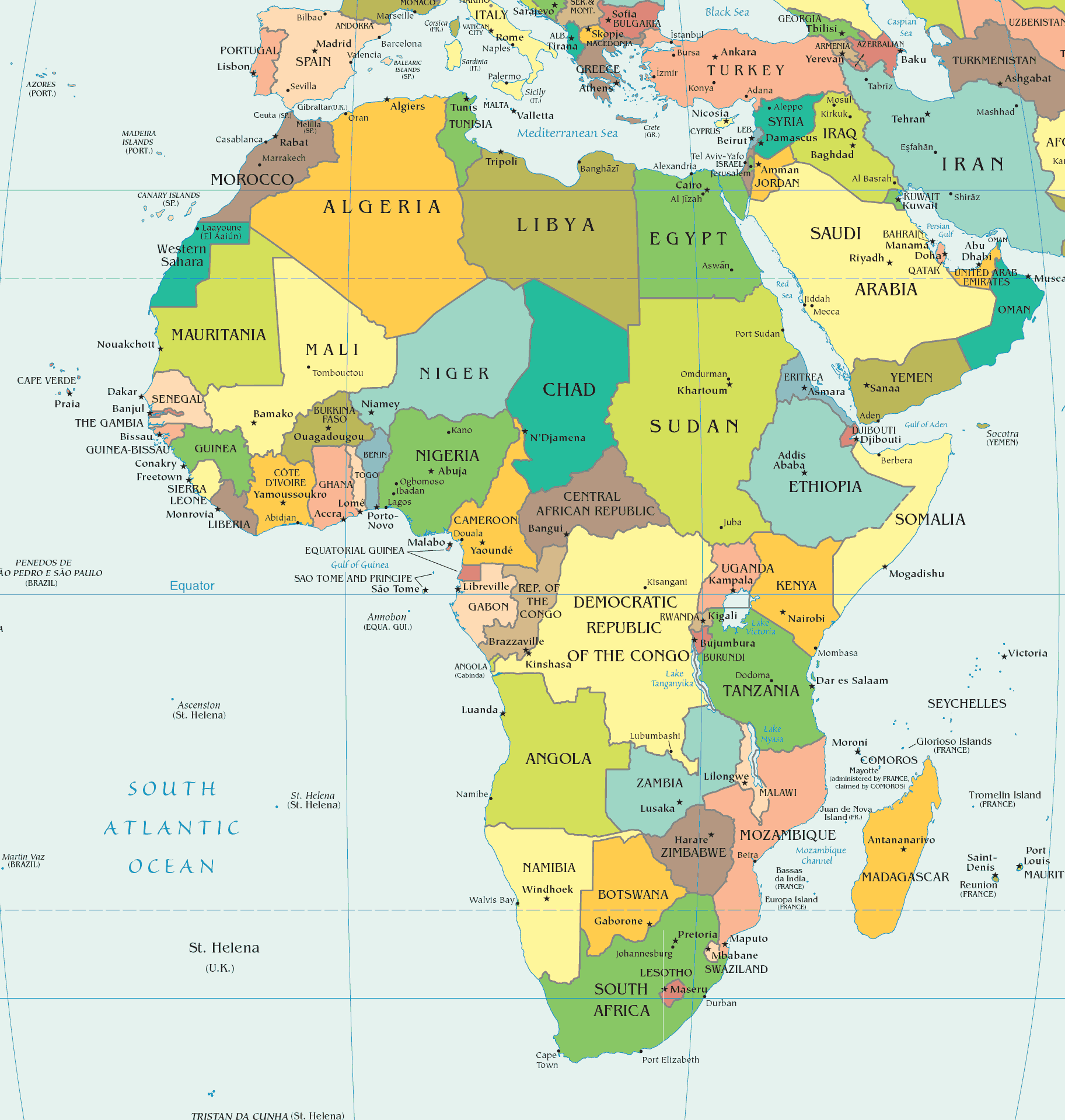
What is its political History?
How could guys like Kony have gone invisible for so long?
How has Social Media changed that?
If you were Joseph Kony would you be nervous?
What will you do if anything to help capture Kony?
Is Joseph Kony the most important social issue out there right now?
What do the people of Uganda think?
Is the film accurate and will the money raised be well spent?
Tuesday, February 28, 2012
Gun Control and The Second Amendment
Last week's school shooting in Cleveland brings up interesting questions about our right to bear arms.
Some argue that it is far to easy for young people to get their hands on guns to carry out such crimes.
While others argue the importance of keeping guns in preserving our freedom?
What do you think?
Monday, February 27, 2012
One Marines Journey

Photojournalist Danfung Dennis has captured the brutalities of the war in Afghanistan for The New York Times, Newsweek, The Guardian and The Washington Post. But as the war stretched on, he started to feel that the images were losing their impact.
"After so many years of war," he tells NPR's Neal Conan, "society's become numb to pictures of conflict, and so I felt like I had to move into a new medium to try to shake people from their indifference."
Read more...
How does this movie differ from reality TV?
Was this an 'anti-war' movie?
Do you think this movie deserved to win the Oscar for best documentary? Why or why not?
What are the costs of war? What are the rewards? Is it worth it?
What do you think should be done about Afghanistan especially given recent headlines?
Wednesday, February 15, 2012
The Taliban

From Time Magazine (July, 2010)
The Taliban pounded on the door just before midnight, demanding that Aisha, 18, be punished for running away from her husband's house. They dragged her to a mountain clearing near her village in the southern Afghan province of Uruzgan, ignoring her protests that her in-laws had been abusive, that she had no choice but to escape. Shivering in the cold air and blinded by the flashlights trained on her by her husband's family, she faced her spouse and accuser. Her in-laws treated her like a slave, Aisha pleaded. They beat her. If she hadn't run away, she would have died. Her judge, a local Taliban commander, was unmoved. Later, he would tell Aisha's uncle that she had to be made an example of lest other girls in the village try to do the same thing. The commander gave his verdict, and men moved in to deliver the punishment. Aisha's brother-in-law held her down while her husband pulled out a knife. First he sliced off her ears. Then he started on her nose. Aisha passed out from the pain but awoke soon after, choking on her own blood. The men had left her on the mountainside to die.
This didn't happen 10 years ago, when the Taliban ruled Afghanistan. It happened last year. Now hidden in a secret women's shelter in the relative safety of Kabul, where she was taken after receiving care from U.S. forces, Aisha recounts her tale in a monotone, her eyes flat and distant. She listens obsessively to the news on a small radio that she keeps by her side. Talk that the Afghan government is considering some kind of political accommodation with the Taliban is the only thing that elicits an emotional response. "They are the people that did this to me," she says, touching the jagged bridge of scarred flesh and bone that frames the gaping hole in an otherwise beautiful face. "How can we reconcile with them?"
Questions for discussion:
1.) How are Aisha’s rights as a person being violated? How would this sort of event be viewed in the United States? Why is it so different in Afghanistan?
2.) What does this type of event say about the US progress in Afghanistan?
3.) Why did we go into Afghanistan to begin with? Should this ongoing conflict be viewed as a success? Why or why not?
Click here to learn more.
Subscribe to:
Posts (Atom)